10 Powerful Inventions Where Helping Others Came Before Profit
February 9, 2026
Some of the world’s most important inventions didn’t become household names because their creators sought wealth — they did it because they chose to help others first.
From lifesaving medicine to safety technology, these innovators shared their breakthroughs with the world, often at great personal or financial sacrifice.
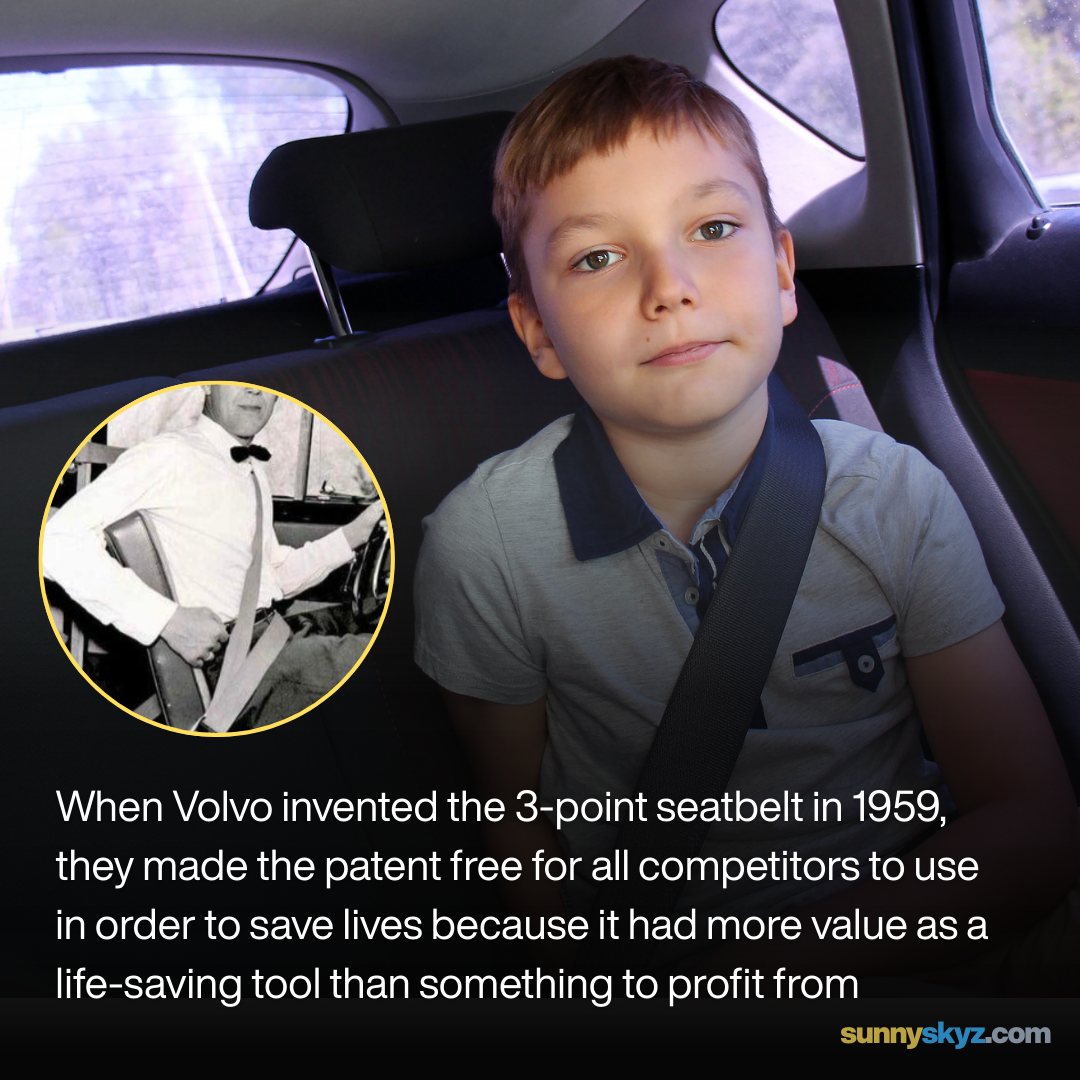
1. Volvo’s Three‑Point Seatbelt
In 1959, Swedish engineer Nils Bohlin designed the modern three‑point seatbelt, a safety breakthrough that dramatically reduced deaths and injuries in car crashes.
Though Volvo obtained patents on the technology, the company chose to make the design available to all car manufacturers (competitors) without charging royalties so it could be used everywhere — saving millions of lives around the world.
2. Benjamin Franklin — Sharing Ideas Freely
Founding Father Benjamin Franklin invented or improved many devices, including bifocals, the lightning rod, and the Franklin stove.
But he never patented any of his inventions, believing that ideas should be shared for the benefit of all rather than hoarded for profit.
3. Insulin — A Cure Offered to the World
In 1921, doctors Frederick Banting, Charles Best, and James Collip isolated insulin, a life‑saving treatment for diabetes.
Rather than hold exclusive rights, they famously sold the patent to the University of Toronto for just $1 each so the discovery could be developed and distributed more freely.
4. Jonas Salk and the Polio Vaccine
When Jonas Salk developed the first effective polio vaccine in the 1950s, he chose not to patent it. Asked who owned the patent, Salk responded, “Well, the people I would say. There is no patent. Could you patent the sun?”
His stance helped the vaccine be widely adopted around the world.
5. Alexander Fleming and Penicillin
Alexander Fleming discovered penicillin in 1928, revolutionizing medicine.
Fleming did not patent his discovery, saying the mold’s antibiotic qualities were a natural phenomenon and should be available for everyone’s benefit.
6. Wilhelm Röntgen and X‑Rays
When Wilhelm Röntgen discovered X‑rays in 1895, he did not seek to patent the technology. He believed such a powerful scientific discovery should belong to humanity and be used to advance medicine without restriction.
While there’s less documentation on formal patent decisions, historical records note Röntgen’s intent for broad scientific access.
7. Monoclonal Antibodies — A Foundation for Countless Treatments
Scientists César Milstein and Georges Köhler developed the technique to produce monoclonal antibodies in the 1970s.
Their original work was not patented, enabling researchers around the world to build on it and develop thousands of life‑saving diagnostic and therapeutic tools.
8. J.M. Barrie and Peter Pan
Author J.M. Barrie gifted the copyright of Peter Pan to the Great Ormond Street Hospital for Children in London.
The hospital still benefits from the rights, and while precise financial figures aren’t public, the decision has supported pediatric care for decades.
9. Miners’ Safety Lamp by Sir Humphry Davy
In 1815, Sir Humphry Davy invented the miner’s safety lamp to reduce the risk of methane explosions in coal mines.
Davy allowed others to copy the design freely, prioritizing miner safety over exclusive rights — enabling widespread adoption of better safety gear.
10. World Wide Web — Made Open for Everyone
Tim Berners‑Lee invented the World Wide Web in 1989. Rather than patenting it or charging royalties, he made the core technologies freely available with no patents and no fees so that anyone could adopt and build on them.
This decision helped the Web spread rapidly around the world, enabling global connectivity, online innovation, and billions of users to freely access information.
Why These Stories Matter
In a world where innovation is often tightly controlled for profit, these inventors remind us of a different legacy — one where the value of an idea is measured by the lives it touches. Their choices helped spread tools, medicines, and safety advancements far beyond what would have been possible through standard commercialization alone.
These examples continue to inspire a culture of sharing and collaboration that benefits all of humanity.
 Dogs Are Forced To Wear The Things They Steal — And It’s Hilarious
 A Dad Keeps a Running List of Every Dog He Meets on His Beach Walks
 After Losing His Right Arm, His Cousin Spent 48 Hours Crocheting Him a New One
 Miles Don't Have to Separate Us; You Just Need to Use Technology!
 Dad and Daughter Pilots Recognize Each Other on the Radio, and It Gets Hilarious
 Shelter Dogs Pick Their Favorite Toys, and Their Reactions Are Priceless
 Trumpet Player SINGS National Anthem After Trumpet Malfunctions
 Strong Man Loses on Purpose So a Dad Can Make His Daughter Proud
 Stray Dog Becomes the Star of a Wrestling Match