Experts Say Newly Discovered Manuscript Is Oldest Written Record Of Jesus' Childhood
June 18, 2024
For decades, a papyrus fragment bearing the inventory number P.Hamb.Graec. 1011 lay unnoticed in the Hamburg Carl von Ossietzky State and University Library.
Recently, it was identified by Dr. Lajos Berkes of the Humboldt-Universität zu Berlin and Prof. Gabriel Nocchi Macedo of the University of Liège as the earliest surviving copy of the Infancy Gospel of Thomas.

This discovery is highly significant for the field of early Christian studies. The newly identified manuscript dates back to the 4th or 5th century, making it the oldest known Greek version of the Infancy Gospel of Thomas.
Previously, the earliest known copy was from an 11th-century codex. The Infancy Gospel, likely written in the 2nd century AD, narrates episodes from Jesus's childhood and is part of the biblical apocrypha—writings not included in the canonical Bible but widely popular in antiquity and the Middle Ages.
Dr. Berkes, a lecturer at Humboldt-Universität, highlighted the fragment’s importance: "It is of extraordinary interest for research, not only because we dated it to the 4th or 5th century but also because we gained new insights into the transmission of the text."
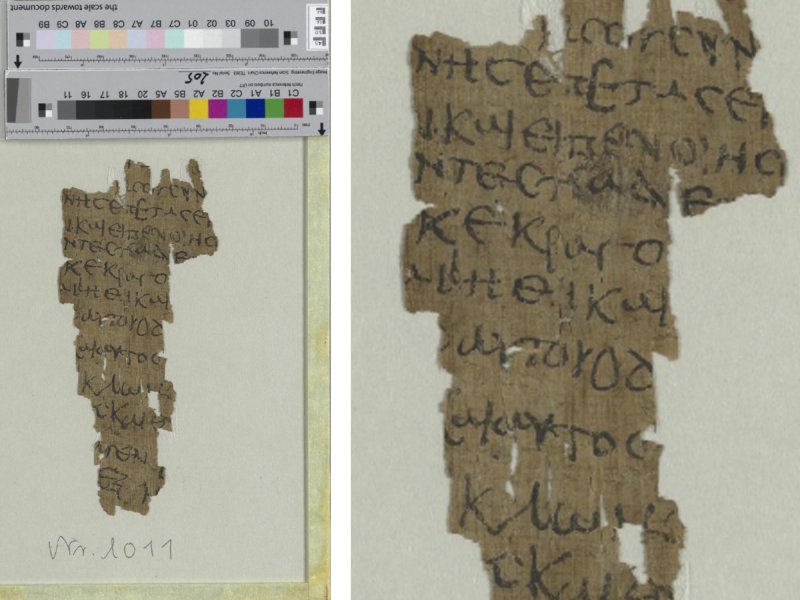
Staats- und Universitätsbibliothek Hamburg/Public Domain Mark 1.0
Prof. Nocchi Macedo added, "Our findings confirm the current assessment that the Infancy Gospel of Thomas was originally written in Greek."
The fragment, measuring about 11 x 5 centimeters, contains thirteen lines of Greek text, with around ten letters per line. Originating from late antique Egypt, it remained unnoticed because its clumsy handwriting led scholars to dismiss it as an everyday document, such as a private letter or shopping list.
Dr. Berkes explained their breakthrough: "We first noticed the word 'Jesus' in the text. By comparing it with numerous other digitized papyri, we deciphered it letter by letter and quickly realized it could not be an everyday document."
Further analysis revealed key terms like 'crowing' and 'branch,' which matched those in the Infancy Gospel of Thomas. The text describes an episode from Jesus's childhood known as the 'vivification of the sparrows,' where a young Jesus brings clay sparrows to life.
The researchers believe this copy was likely a writing exercise from a school or monastery, as suggested by the irregular handwriting.
Why isn't the Gospel of Thomas in the Bible?
The Gospel of Thomas, along with other apocryphal writings, was rejected by mainstream Christianity for several reasons. Its Gnostic elements, uncertain origins, and significant theological differences from the canonical Gospels contributed to its exclusion from the New Testament.
The Gospel of Thomas does not mention key events like the crucifixion and resurrection of Jesus, which are central to Christian theology.
Unlike the canonical Gospels, which were attributed to apostles or close associates of apostles (Matthew, Mark, Luke, and John), the Gospel of Thomas did not have a clear apostolic origin.
The Gospel of Thomas contains sayings and teachings attributed to Jesus that differ significantly from those in the canonical Gospels (Matthew, Mark, Luke, and John).
 Stray Dog Becomes the Star of a Wrestling Match
 Grateful Man Celebrates His 60th Birthday With Pizza, Receives Thousands Of Birthday Wishes
 Two Cats Sitting Under an Umbrella Have the Internet Asking One Very Important Question
 Dad Tells His Children He Won The Nobel Prize In Medicine
 She Broke Her Nose the Night Before Her Daughter’s Wedding
 Photographer Captures Dogs “Flying” Through the Air, and the Photos Are Pure Joy
 Hero Chick-fil-A Employee Saves Woman and Baby
 Dad Goes Viral for Dancing at Olivia Rodrigo Concert With His Daughters