Scientists Grew A Beating Human Heart In The Laboratory Using Stem Cells
March 22, 2016
A team of researchers have successfully grown a beating human heart in the laboratory using stem cells.
Right now, there are 4,186 people waiting for a heart transplant in the U.S., but with a huge donor shortage not all of these patients are likely to survive. Growing transplantable hearts in a laboratory has been a long-standing dream within the medical community, and a study in the journal Circulation Research has moved it one step closer to reality.
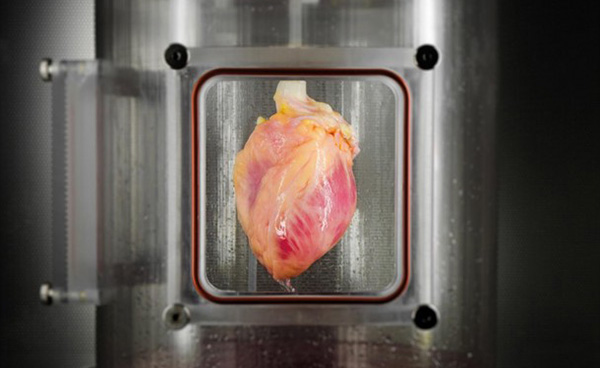
Bernhard Jank, MD, Ott Lab, Center for Regenerative Medicine, Massachusetts General Hospital
Previous research has shown how 3D printers can be used to manufacture 3D heart segments using biological material. Although vacant of any actual heart cells, these structures provided the "scaffold" on which heart tissue could be grown. Now, a team from both Massachusetts General Hospital (MGH) and Harvard Medical School has taken this scaffolding concept and combined it with stem cells for some truly spectacular results.
The main problem with heart transplants, other than a lack of donors, is that there’s a chance that the receiver’s body will reject the new organ.
For this study, 73 human hearts deemed unsuitable for transplantation were carefully immersed in solutions of detergent in order to strip them of any cells that would provoke this self-destructive response. What was left was a matrix (or “scaffold”) of a heart, complete with its intricate structures and vessels, providing a new foundation for new heart cells to be grown onto.
This is where stem cells come in.
After just two weeks, the networks of lab-grown heart cells already resembled immature but intricately structured hearts. The team gave them a burst of electricity, and the hearts actually started beating.
"Among the next steps that we are pursuing are improving methods to generate even more cardiac cells," said Jacques Guyette, a biomedical researcher at the MGH Center for Regenerative Medicine and lead author of the study, in a statement. Although this study manufactured a whopping 500 million stem cell-derived heart cells for the procedure, regrowing a whole heart would actually take "tens of billions," Guyette added.
So despite falling short of growing an entire, mature human heart in a laboratory from a patient's own cells, this is the closest anyone has come to date to reaching this goal – and that in itself is a breathtaking achievement.
via IFLScience
 Dogs Are Forced To Wear The Things They Steal — And It’s Hilarious
 Woman Creates Hilariously Detailed Information Sheets For Friends Watching Her Cats
 “He Cried”: Fan Had a Spare Ticket to the Game, So He Gave It to a Homeless Man
 His Girlfriend Brought Home a Cat He Didn’t Want. Now, They’re Best Friends
 5 Genuinely Wholesome Things Happening on Video Calls Right Now
 93-Year-Old Woman Wakes Up to a Bobcat in Her Home
 She Threw Her Cat a Quinceañera, and It Saved an Animal Shelter
 Family's Birthday Tradition Brings 5-Year-Old Boy To Tears
 Supermarket Manager Saves Little Girl From Oncoming Traffic Just In Time