On February 28, A Rare Planetary Parade Will Appear In The Evening Sky
February 24, 2026
Later this month, skywatchers will have a rare reason to look up. A six-planet “alignment” — often called a planet parade — will briefly appear in the evening sky, creating a stunning celestial lineup just after sunset.
According to Space.com, the alignment will be visible soon after sunset on Saturday, February 28, when six planets — Jupiter, Saturn, Uranus, Neptune, Venus and Mercury — will appear grouped together from our perspective on Earth.
While not all six will be visible to the naked eye, the sight of multiple planets sharing the same stretch of sky is still a special event.
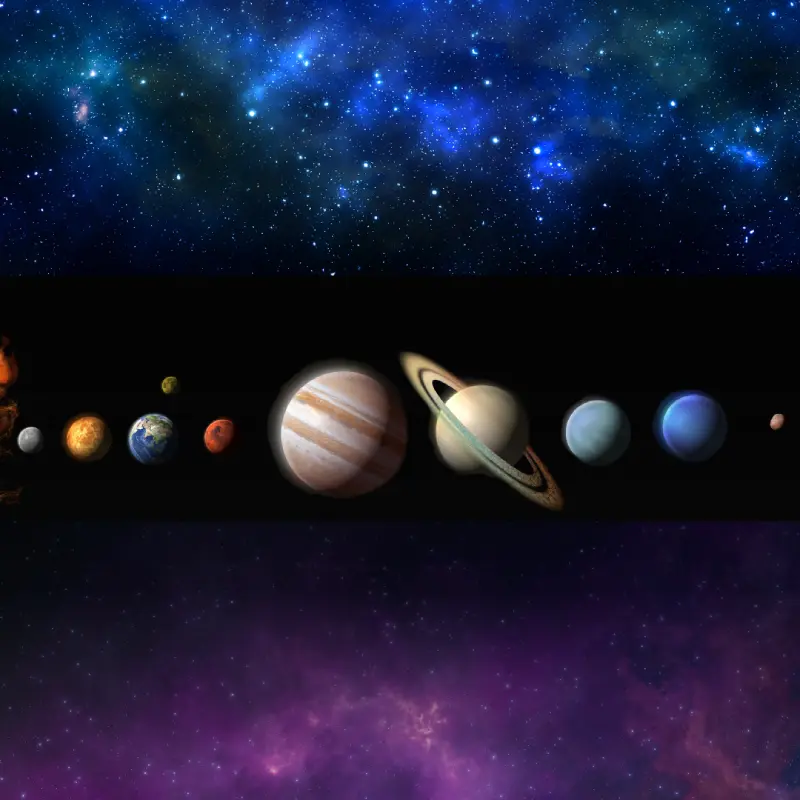
What Is a Planetary Alignment?
Planetary alignments happen every few months to every few years, typically involving three to five planets appearing close together. But a grouping of six or seven planets is much less common. NASA explains that the effect happens because the planets orbit the Sun along the same path — known as the ecliptic. As they move at different speeds, there are times when several appear clustered together from Earth’s point of view.
In reality, they aren’t forming a perfectly straight line in space. It simply looks that way because of our viewing angle.
“These planets appear grouped in the night sky as their orbits happen to place them on the same side of the Sun during this period,” explained Dr. Shyam Balaji, a researcher in astroparticle physics and cosmology at King’s College London.
He also emphasized that while planetary alignments have inspired cultural and astrological interpretations throughout history, they have no physical impact on Earth.
“These alignments have no gravitational effects on Earth. Their combined gravitational pull of the planets on Earth is negligible compared to that of the Moon or the Sun. Planetary alignments have often inspired cultural or astrological interpretations, but scientifically they are predictable geometrical coincidences with no known physical influence.”
Where - And When - To Look
The best viewing window will be about 30 minutes to one hour after sunset, facing the western sky.
Four of the planets — Saturn, Neptune, Venus and Mercury — will sit low on the horizon and close to the Sun, meaning they’ll only be visible briefly before they dip out of sight. Some planets, such as Uranus and Neptune, typically require binoculars or a telescope to spot.
Still, even catching a glimpse of a few planets sharing the twilight sky is a reminder of just how dynamic our solar system really is.
A Short-Lived Show
This cosmic gathering won’t last long. Because each planet travels at its own speed, the alignment will gradually shift in the days that follow.
If you miss this one, you’ll have to be patient. The next planetary parade is expected in October 2028 — but that event will include only five planets.
After that, another six-planet alignment isn’t expected until February 2034.
For one evening, though, our solar system will put on a quiet, predictable and beautiful show. Sometimes the best good news is simply a reminder to step outside, look west, and watch the universe in motion
 Stray Dog Becomes the Star of a Wrestling Match
 Grateful Man Celebrates His 60th Birthday With Pizza, Receives Thousands Of Birthday Wishes
 Two Cats Sitting Under an Umbrella Have the Internet Asking One Very Important Question
 The Best Sports Tradition Ever: The Hawkeye Wave
 These Middle Schoolers Made a 5-Year-Old’s Birthday Unforgettable
 Kittens Take A Field Trip To The Aquarium
 Dad Tells His Children He Won The Nobel Prize In Medicine
 She Broke Her Nose the Night Before Her Daughter’s Wedding