High School Science Teacher Finds Something Scientists Had Never Seen Before: A T. Rex Trackway
September 12, 2026
A high school science teacher went fossil hunting in North Dakota and ended up discovering something scientists had never documented before: a trail of footprints left by a full-grown Tyrannosaurus rex.
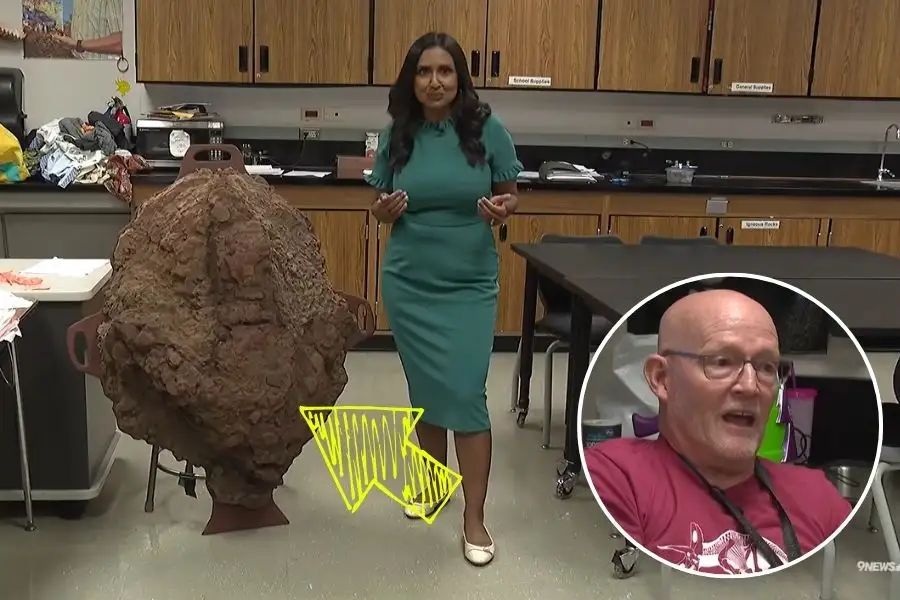 Credit: 9 News / Kent Hups (right)
Kent Hups, a science teacher at Northglenn High School in Colorado and longtime volunteer with the Denver Museum of Nature & Science, made the extraordinary discovery in 2025 while volunteering on a paleontology dig in the Hell Creek Formation near Marmarth, North Dakota.
There was one small problem. Hups had recently undergone knee replacement surgery, making the steep, rugged terrain especially difficult to navigate.
"I just had my knee replaced, so I was hobbling around a little bit," he recalled.
Instead of trying to scramble up and down the hills with everyone else, Hups decided to search the area at a slower pace.
That decision changed paleontology history.
About 23 feet away, he spotted something that immediately caught his attention.
"It was probably about 23 feet away," Hups said. "You start going through your mind, 'So, how do I prove it's a track? And what kind of animal left the track?'"
What looked like an unusual formation to most people turned out to be four enormous, three-toed footprints preserved in the rock.
Each footprint is roughly three feet long, and together they form a trackway stretching about 23 feet across the ancient landscape.
Scientists believe the footprints belonged to an adult T. rex based on their size and shape, along with the unusually large number of tyrannosaur fossils found in the surrounding area.
But what makes the discovery especially remarkable is that these aren't simply four footprints found in different places.
They are connected.
Before this discovery, scientists had confirmed only two isolated footprints attributed to adult T. rex anywhere in the world. Neither could show researchers how the animal was moving.
Now, for the first time, scientists have a sequence of tracks that allows them to follow the path of a full-grown T. rex.
By studying the spacing between the footprints, researchers estimate the enormous predator was walking between 3.5 and 4.5 miles per hour, roughly the pace of a brisk human walk.
And that's what makes a trackway so special.
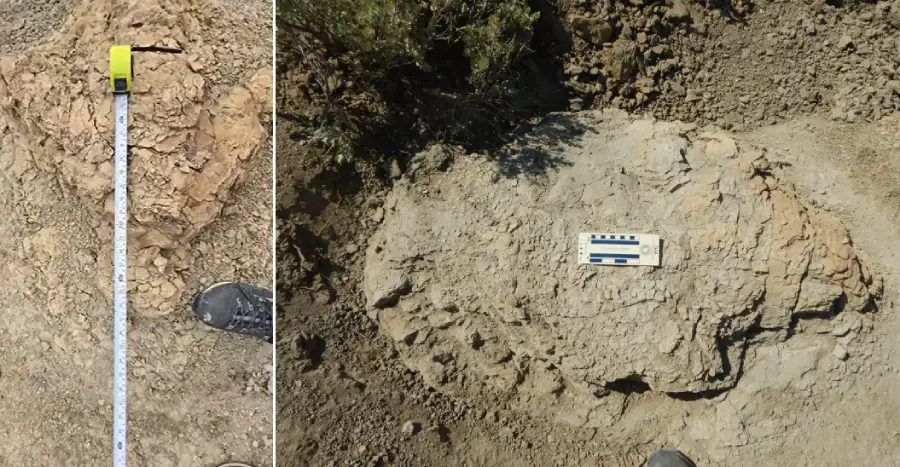 Credit: Kent Hups / National Science Foundation
"Bones tell us an enormous amount about these animals, but footprints capture a moment of behavior," said Dr. Tyler Lyson, senior curator of vertebrate paleontology at the Denver Museum of Nature & Science. "With a trackway, we can actually follow an animal as it moved across the landscape. That is incredibly rare for T. rex."
Hups knows a thing or two about curiosity. As a teacher, he has spent years encouraging his students to explore science and ask questions, never imagining that his own curiosity would lead to such an extraordinary discovery.
"As a teacher, I'm always telling my students that science starts with curiosity, passion and careful observation," Hups said. "I never imagined that could lead me to a discovery like this."
His discovery is now giving his students a chance to experience that same sense of wonder.
During a paleontology club meeting, students painted a 3D model of one of the enormous footprints.
"Having the privilege now to have a part in this because of Mr. Hups and because I wanted to join the paleontology club is just, it fills my soul with so much joy," said 10th-grade student Alexandra Acosta.
For Acosta, the discovery also offered a much bigger perspective.
"Life continues even after things go extinct," she said. "Life, it's so big and humans are such a small part of it, and this really puts it into perspective."
Three of the four footprints are expected to be removed from the site by helicopter this fall and brought to the Denver Museum of Nature & Science, where they can be studied and eventually shared with the public.
For Hups, the real magic of the discovery is what those ancient footprints allow us to imagine.
"That's the neat thing about a trackway, it allows you to go back in time and see what the area was like when this thing was walking around," he said. "It's the closest you get to a time machine."
 Dogs Are Forced To Wear The Things They Steal — And It’s Hilarious
 Woman Creates Hilariously Detailed Information Sheets For Friends Watching Her Cats
 “He Cried”: Fan Had a Spare Ticket to the Game, So He Gave It to a Homeless Man
 His Girlfriend Brought Home a Cat He Didn’t Want. Now, They’re Best Friends
 5 Genuinely Wholesome Things Happening on Video Calls Right Now
 93-Year-Old Woman Wakes Up to a Bobcat in Her Home
 She Threw Her Cat a Quinceañera, and It Saved an Animal Shelter
 Family's Birthday Tradition Brings 5-Year-Old Boy To Tears
 Supermarket Manager Saves Little Girl From Oncoming Traffic Just In Time